Five years to 2030: what the SDG scorecard is really telling us
Only about a third of SDG targets are on track. Here is what the 2025 report says beyond the headline, and why the real gap is implementation.
October 19, 2026
Isaac Lemayian1 min read
Share
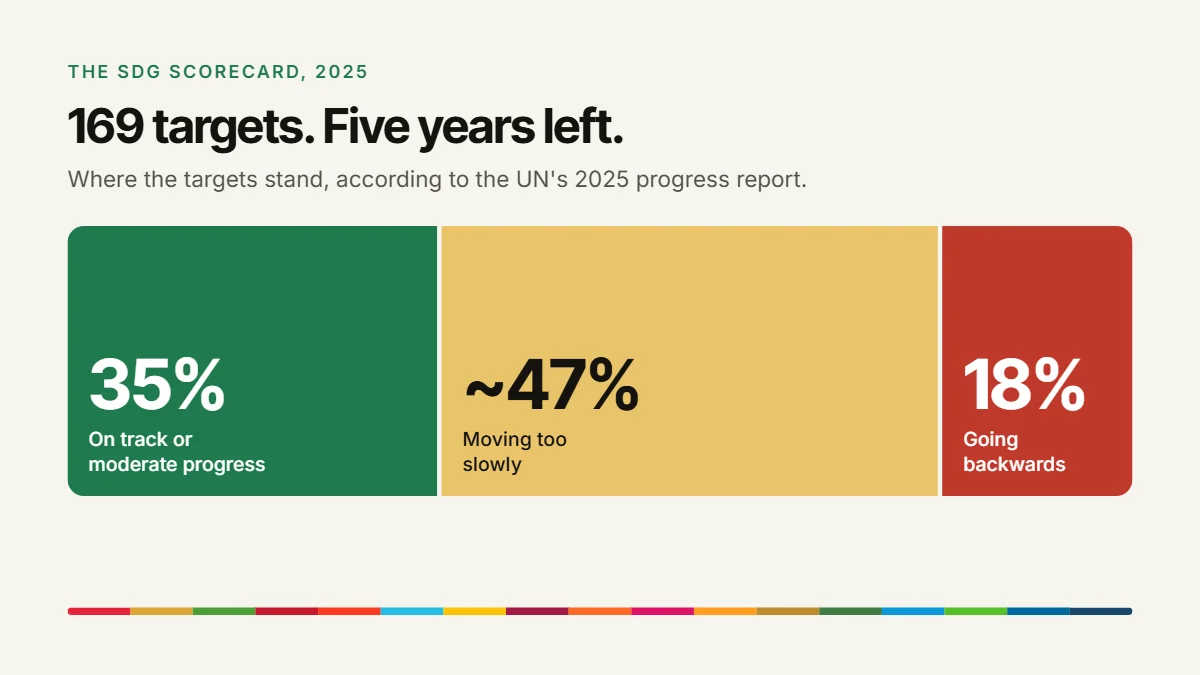
Every July, the United Nations publishes the SDG scorecard: a report card on the world’s promise to itself. The 2025 edition carried a sentence that is hard to read twice. Of the 169 targets behind the Sustainable Development Goals, only about 35% are on track or making moderate progress. Nearly half are moving too slowly, and 18% have gone backwards.
We are five years from 2030. I study how the SDGs are managed and implemented, and I keep coming back to one simple question: what is the scorecard actually telling us, beyond “we are failing”?
More than 800 million people still live in extreme poverty, and nearly one in eleven people faced hunger in 2023.
2024 was the hottest year on record, about 1.55°C above pre-industrial levels.
Low- and middle-income countries paid a record US$1.4 trillion in debt service in 2023, while development aid fell in 2024.
And yet:
Internet use rose from 40% of people in 2015 to 68% in 2024.
92% of the world now has electricity.
New HIV infections have fallen by nearly 40% since 2010, and 110 million more children and young people have entered school since 2015.
Progress is real. It is just uneven, and too slow for the deadline we set.
Why the SDG scorecard is about systems, not goals
My training is in Chemistry and Biology, and one lesson from the lab stays with me: a reaction does not happen because you wrote the equation down. You need the right conditions, the right concentrations and enough energy to get over the barrier.
The SDGs are a very good equation. They describe the world we want in 17 goals that almost every government signed. However, they cannot create the conditions on their own: the institutions, budgets, data and day-to-day coordination that turn a target into a clinic that opens on time, or a borehole that still works five years later.
So when I read the 2025 SDG scorecard, I do not see a failure of ambition. I see a gap between ambition and implementation, and that gap is where most development work actually happens.
Three things the SDG scorecard is really about
1. Money that moves in the wrong direction
When countries spend more on servicing debt than on health or education, the SDGs become goals they simply cannot fund. No amount of strategy fixes a budget that is flowing out of the country. That alone explains a lot of the red on the SDG scorecard.
2. Data that arrives too late
Many indicators are measured years after the fact, and some barely at all. It is hard to steer a programme with a map drawn three years ago. In other words, the SDG scorecard often describes the past, not the present. Better, faster and more local data is not glamorous. Still, it is how we would know what is working while there is time to adjust.
3. Knowledge that does not travel
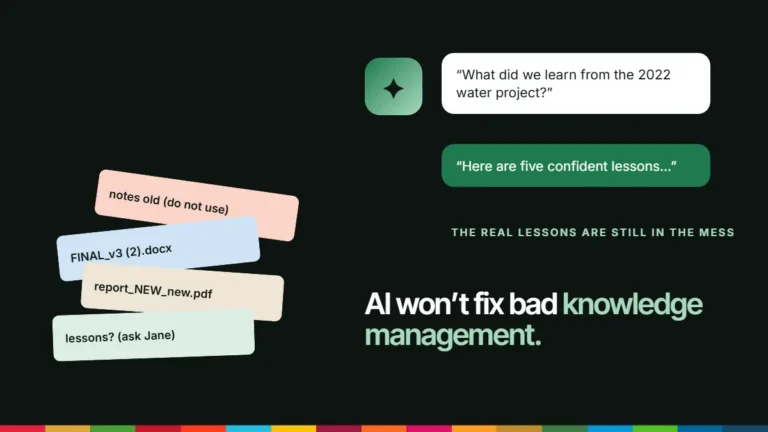
Somewhere, someone has already solved part of almost every problem the SDGs describe. A county that improved maternal health. A cooperative that made water points last. A school that kept girls enrolled. Too often, that knowledge stays in a report nobody reads, or in the head of someone who has moved on. This is why I care about knowledge management, and why I wrote about why development organisations forget what they learn. It is the unglamorous plumbing of sustainable development.
What the SDG scorecard means from where I sit
I am writing this from Nairobi, as a student and as someone who has worked on the edges of programmes rather than at the top of them. From here, the most useful response to the scorecard is not despair. Instead, it is a set of practical questions I want to keep asking:
Who is responsible for this target in practice, not just on paper?
What would we need to know, and how quickly, to tell whether it is working?
Where has this already worked, and how do we learn from it?
The 2030 deadline was never the point. The point was a direction, and a way of holding each other accountable for moving in it.
Five years is not long. But it is long enough to stop treating the SDGs as a scoreboard and start treating them as a system we can still repair. If you want to see how my own work connects to the goals, have a look at my global goals page.
A letter from Nairobi in 2026, to grandchildren who may grow up among the stars, about the planet we had,...
Let’s talk
Ideas are better shared.
If this piece sparked a thought, a question or a disagreement, I’d love to hear it. I am open to conversations around sustainable development, knowledge and digital innovation.