AI Won’t Fix Bad Knowledge Management. Here’s What Will.
AI can make knowledge work faster, but only if your knowledge is in order. What the research says about AI and knowledge management, and five simple fixes.
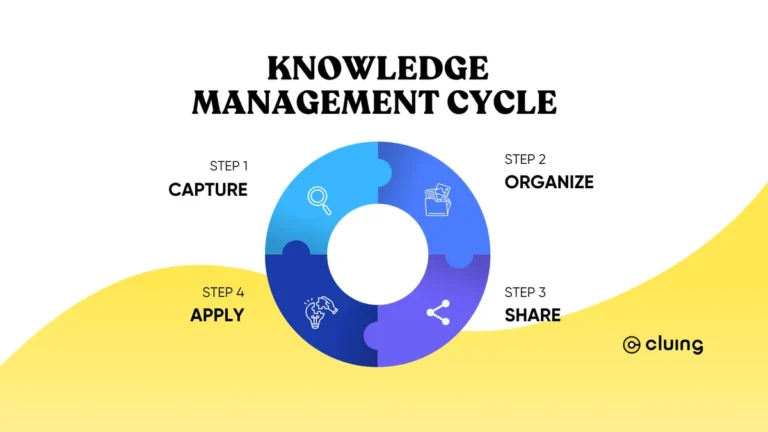
October 28, 2026
Isaac Lemayian1 min read
Share
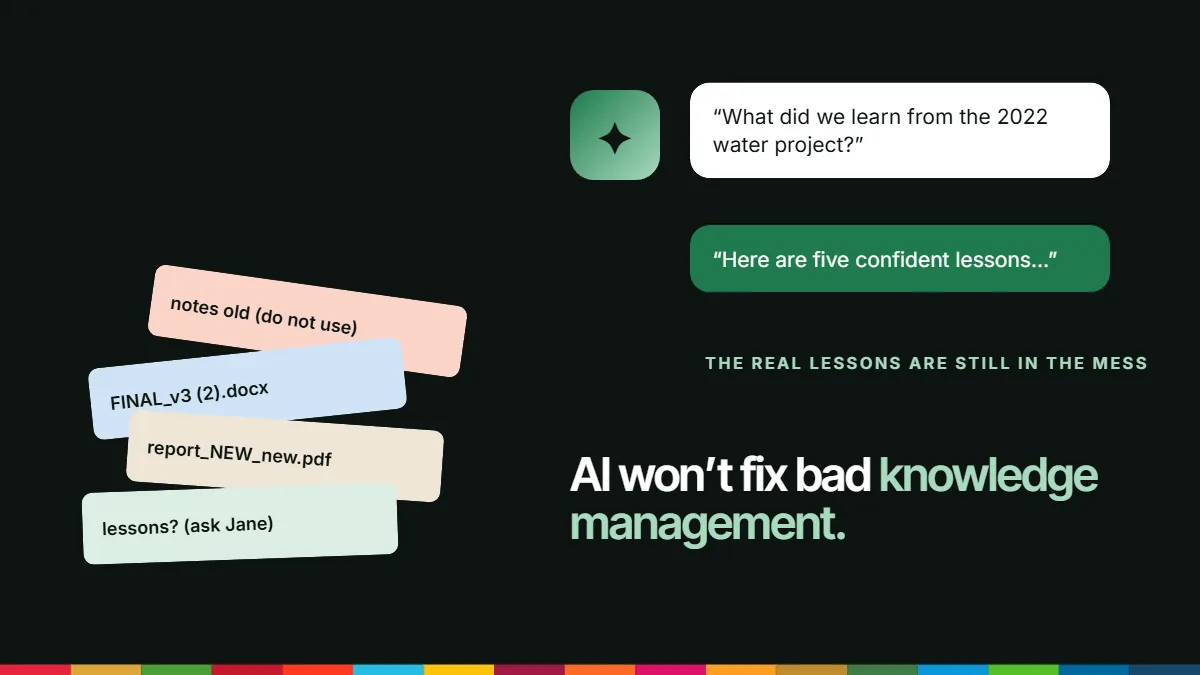
Picture this. Your organisation is excited about AI and knowledge management, so it buys a famous new AI assistant. On day one, someone asks it a simple question: “What did we learn from the 2022 water project?”
The AI answers in seconds. It sounds confident. However, it is also wrong.
Why? Because the real lessons are sitting in an email thread, on a colleague’s laptop, or in a file called FINAL_v3 (2).docx. After all, the AI cannot find what nobody wrote down or saved properly.
I spent months reading the research on AI and knowledge work for my paper, Smarter Work, Not Harder Work. In the end, my main conclusion is simple: when it comes to AI and knowledge management, AI does not replace knowledge management. It depends on it.
The good news: AI really can help
First, let me be fair to AI. While writing my paper, I went through the strongest studies on AI at work. The evidence is real, and it keeps growing.
Customer support. In a study of more than 5,000 support agents, an AI assistant helped them solve 14% more issues per hour. Newer agents gained the most, at 34%.
Consulting. At a large global firm, consultants using AI finished more tasks, worked about 25% faster and produced better work.
One detail stands out to me. In the support study, the AI spread the habits of the best workers to everyone else. In other words, it worked partly as a knowledge-sharing tool. That is knowledge management under a new name.
The catch: the gains are not automatic
However, here is the part that gets left out of most sales pitches.
In the same consulting study, there was one task that the AI was not good at. Consultants working without AI got it right 84% of the time. Those using AI got it right only 60 to 70% of the time. In other words, they trusted the tool on a task it could not handle.
And across companies, adoption is not the same as results. In McKinsey’s 2025 State of AI survey, nearly nine in ten organisations said they use AI regularly. But only 37% reported any impact on profit, and only about 6% were seeing large gains.
So what separates the few from the many? McKinsey found that the top group were far more likely to redesign how work gets done, rather than simply adding AI on top of old habits.
Why AI and knowledge management go together
To begin with, AI tools are only as good as what they can reach. Think of it like a very fast new colleague who joins your team. For example, they can read everything in seconds. But if your files are a mess, they will read the mess very quickly.
Here are the problems I see most often in organisations:
Many versions, no truth. Five copies of the same report, and nobody knows which one is final.
Knowledge stuck in heads. The most useful lessons were never written down. They left when the project ended or when a staff member moved on.
Names that mean nothing. “New folder”, “Notes old”, “Report_NEW_new”. Neither a person nor an AI can make sense of that.
Old information that looks current. Meanwhile, outdated policies sit next to new ones, with no date or label.
Feed that into an AI tool and you get confident answers built on shaky ground. In short, this is not a technology problem. It is a knowledge management problem.
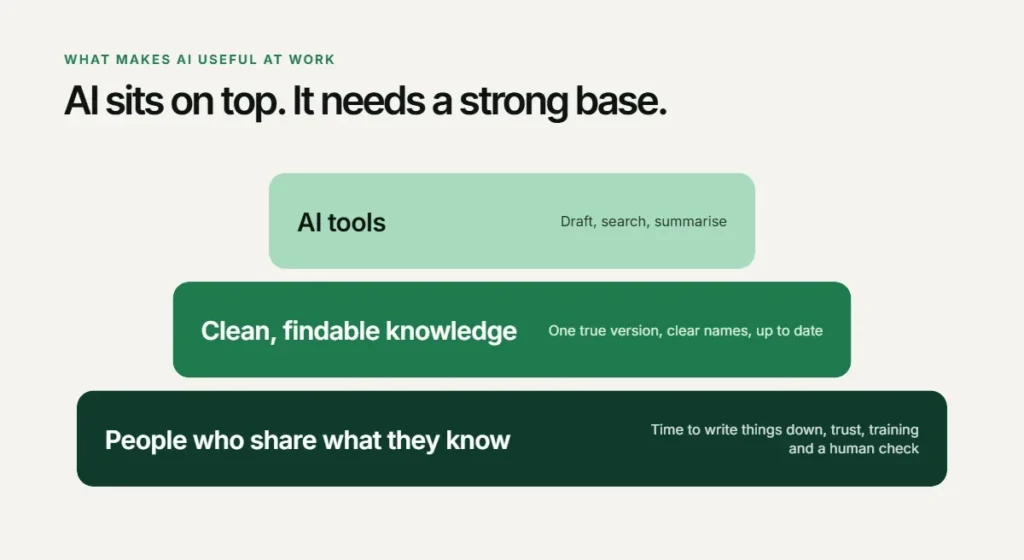
AI sits on top. It needs a strong base of good knowledge and people who share it.
What actually works for AI and knowledge management
If you want AI and knowledge management to work together, start with the basics. Also, none of these steps need a big budget.
1. Decide on one true version
Pick one place where final documents live. When something is updated, archive the old version and label it clearly. As a result, your future self and your AI tools will thank you.
2. Write down what people know
After every project or big event, hold a short “what did we learn?” session. Then write the answers down in plain language and save them where people can find them. Above all, this is where most lost knowledge can be saved.
3. Use simple names and dates
A file called “2026-03 Water project lessons learned (final)” is easy to find. A file called “notes2” is not. So agree on a simple naming style and stick to it.
4. Redesign the work; do not just add AI
First, ask where AI can genuinely save time in a process, then change the process around it. Adding a chatbot to a broken workflow just gives you a faster broken workflow.
5. Train people and keep a human check
AI is strong at some tasks and weak at others, and the line is not always obvious. For this reason, train your team to know the difference. For anything important, a person should check the output before it goes out.
A simple AI and knowledge management test
Ask yourself this: could a new colleague find the answer in 10 minutes, without asking anyone?
If the answer is no, an AI tool will struggle too. In that case, fix that first. Then AI becomes a real multiplier instead of an expensive guessing machine.
The bottom line on AI and knowledge management
I am genuinely excited about AI. I use it, I study it, and I believe it can help development organisations do more with less. But the organisations that will win are not the ones with the fanciest tools. Instead, they are the ones that take care of their knowledge.
AI and knowledge management are partners, not rivals. Look after your knowledge, and AI will look after your productivity.
A letter from Nairobi in 2026, to grandchildren who may grow up among the stars, about the planet we had,...
Let’s talk
Ideas are better shared.
If this piece sparked a thought, a question or a disagreement, I’d love to hear it. I am open to conversations around sustainable development, knowledge and digital innovation.